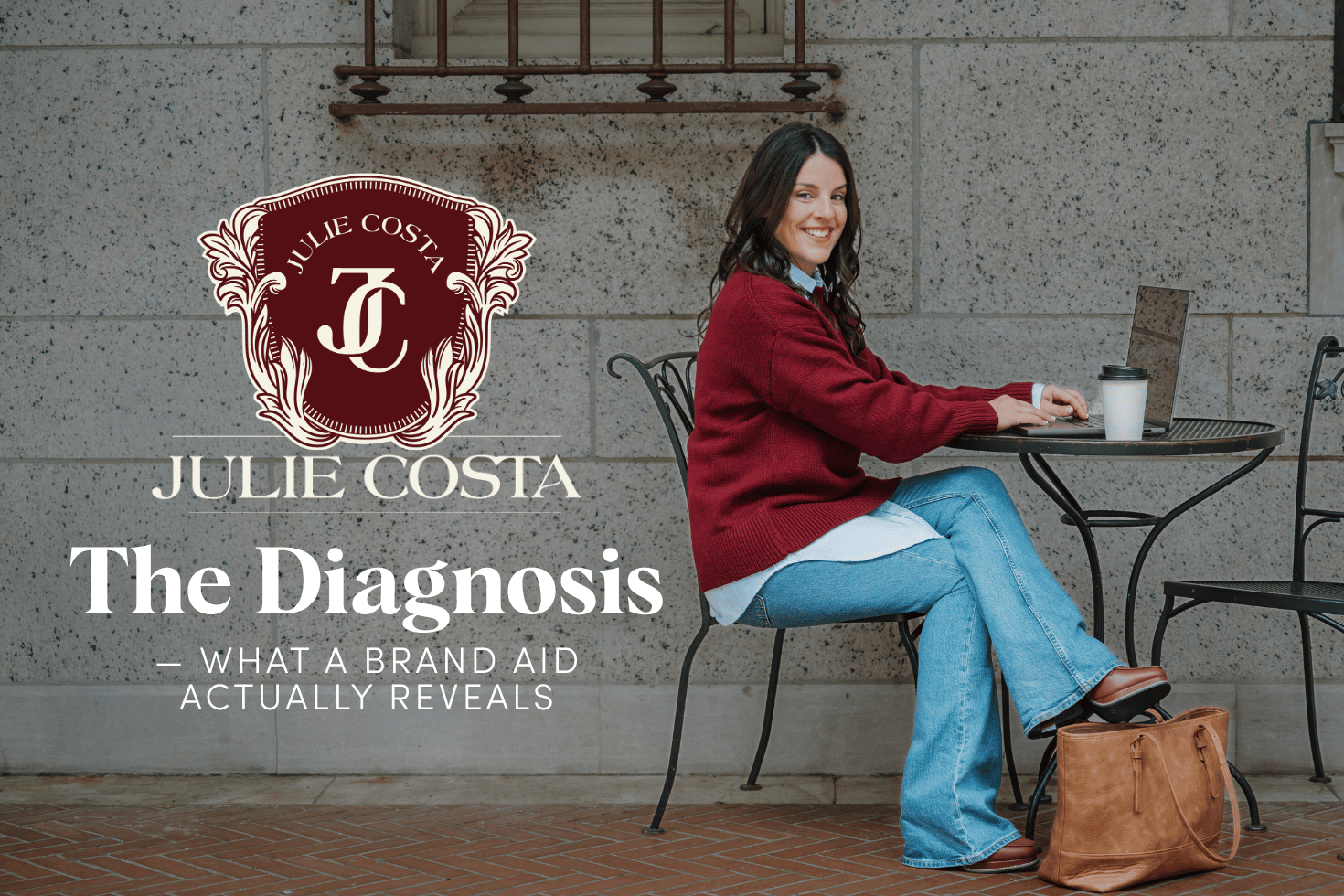
Julie Costa walked into her Brand Aid session as a Master Hypnotherapist and NLP Trainer with the certifications, the client transformations, and the track record to prove she belonged at the top of her field. She walked out of it with something she didn’t have going in: a clear-eyed account of exactly where her brand was working against her.
That’s the part people skip when they picture a rebrand. They imagine the reveal, the new logo, the new website going live. They don’t picture the two hours at the beginning where nothing gets designed and nothing gets written, because that’s not the point of the session yet. The point is understanding. My eyes, my ears, and my full attention wrapped around someone’s business so I can make observations and recommendations from a place of knowing, not assumption. Everything that came after Julie’s Brand Aid, every messaging decision, every visual choice, traces back to what came out of that room
Where Julie Started
On paper, Julie’s business was working. She’d built an impressive offer suite that ranged from one-on-one hypnotherapy sessions all the way up to Anchored, her practitioner certification program. She had the corporate leadership background from her years at lululemon, the entrepreneurial instincts that built The Sweat Republic from nothing, the pivot into Digital Business Builder when the world shut down in 2020. She had, in other words, exactly the kind of resume that should have made her brand feel unshakeable.
It didn’t. And once we sat down together, it became clear why.
What the Session Revealed

Julie was facing three problems, and none of them were about talent.
The first was structural. Julie’s offer suite was genuinely impressive, but there was no clear way for someone to look at it and know which path was theirs. A person exploring one-on-one breakthrough work and a practitioner considering certification were two entirely different buyers with two entirely different sets of questions, and Julie’s brand was speaking to both of them in the same voice, at the same time, without ever pointing either one toward a decision. Muddy audience segmentation doesn’t just confuse a website visitor. It quietly caps growth, because nobody converts from a maze.
The second problem was harder to hear, and I said it to her with as much love as I could put behind it: her brand was reading like generic early-2010s coach. Not because the work behind it was generic. It never was. But brands built by hypnotherapists and NLP practitioners tend to reach for the same visual and verbal shorthand, the same soft language, the same reassuring palette, and Julie’s had drifted into that same well-worn groove. None of it communicated the actual depth of what she does. A woman with Julie’s credentials, working at the intersection of neuroscience, behavioral psychology, and leadership development, was showing up sounding like she was still finding her footing. She wasn’t. Her brand just hadn’t caught up to where she already stood.
The third problem was the one that made the whole picture click into focus. Julie trains people. Every practitioner she certifies through Anchored goes on to build a business of their own, often borrowing the same calm, muted aesthetic that’s become the default across the hypnotherapy and NLP space. Which meant the more successful Julie became as a trainer, the more her own brand started blending into the very field she was leading. Her students, her peers, and Julie herself were all beginning to look, sound, and feel the same. That’s not a branding inconvenience. That’s an authority problem. You cannot lead a field you’re indistinguishable from.
I’ve spent nearly two decades sitting across from business owners in this exact kind of session, and the pattern in Julie’s case was one I recognized immediately, even though the specifics were entirely hers. The people who are the most expert in their field are often the ones whose brands lag the furthest behind their actual authority, because they’re too busy doing the work to notice the gap forming. Julie hadn’t fallen behind. Her brand had.
Why This Always Comes First
None of this got solved with a new logo, and it couldn’t have been. A designer handed these three problems without the strategy underneath them would have made confident guesses and landed somewhere close to right, which in brand work is the same as landing wrong. Julie didn’t need better visuals layered onto an unclear structure. She needed the structure named first: who each offer was actually for, what made her methodology different from the growing field of practitioners she’d trained, and what it would take for her brand to finally sound like the authority she already was.
That’s the order this work has to happen in. Strategy first, always, because every visual decision that follows is either an expression of real clarity or a guess dressed up to look confident. Julie’s Brand Aid gave us the first kind. It gave us a positioning built around the actual distance between what her clients already know and what they haven’t yet been able to do, the exact gap her methodology exists to close. It gave us language for two distinct audiences instead of one blurred one. And it gave Julie something she hadn’t had in a while: a brand strategy that finally matched the caliber of the work she’d been doing all along.
That diagnosis became the foundation for everything that came next, the messaging, the positioning, the visual direction, all of it built on what we found in that room rather than on assumption. What we uncovered from there, and the specific choices it led to, is where the next episode of this series picks up.
If you recognize any part of Julie’s story in your own brand, that recognition is data, not a coincidence. The path forward starts the same way hers did. A Brand Aid session where I get my eyes and ears and full attention wrapped around your business so we can build from understanding instead of assumption.